

The carpet plot is a powerful diagnostic view in the Data Quality Report and is also available in Data Preview before running the analysis. It gives a complete overview of the irradiance data over the entire analysis period and answers very basic but critical questions:
- Does this data look physically realistic for this location and time of year?
- Are there issues that repeat day after day?
- Is data available at all?
Before looking at calibration, orientation, or agreement with reference data, the carpet plot helps confirm that the dataset is fundamentally sound. Many serious problems can be identified here quickly, often before any numerical test is evaluated. Moreover, the basic problems that can easily be detected on the Carpet plot are often critical for the success of more sophisticated analysis.
Use Carpet plot to check the following:
- Data is available, gaps match expected schedule and known downtime periods.
- Annual and diurnal patterns match the location.
- There are no signs of significant time shifts due to time zone mistakes, corrupted datalogger settings or mistakes in data preparation.
- Irradiance value range matches expected irradiance levels.
- Nighttime readings are close to zero.
- Plot asymmetry matches the plane of array orientation.
What is the Carpet plot
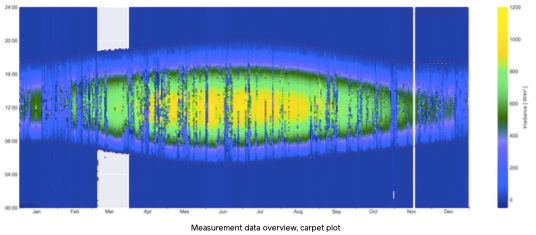
The carpet plot displays all measurements in a single image. The horizontal axis represents the progression of days through the year, typically from January to December. The vertical axis represents the time of day, usually from midnight at the bottom to midnight at the top. Each point in the plot is colored according to the irradiance value measured at that moment, with darker colors representing lower irradiance and brighter colors representing higher irradiance. The values on the colorbar should correspond to expected irradiance levels for the location and time of the year.
For more details see What is Carpet Plot
Time shift on Carpet plot
When the data is healthy, the carpet plot forms a clear and recognizable pattern that follows the movement of the sun. Daytime irradiance appears as a band of color that rises in the morning, peaks around midday, and gradually decreases toward sunset.
This band becomes wider in summer and narrower in winter as the length of the day changes. In equatorial regions, however, there should be little seasonal variation in day length, so the band remains relatively consistent throughout the year.
Outside of daylight hours, the plot remains mostly dark, reflecting the absence of solar radiation at night.
Below are two examples. The first shows a northern country, where the difference in irradiance between summer and winter is very pronounced, both in terms of intensity and daylight duration. The second example represents a tropical country in the Southern Hemisphere, where the seasonal difference in irradiance is much smaller, as is the variation in daylight duration.
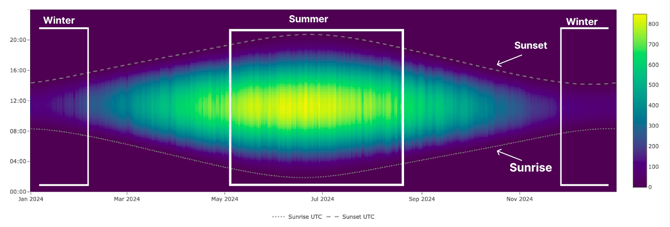
Northern Country
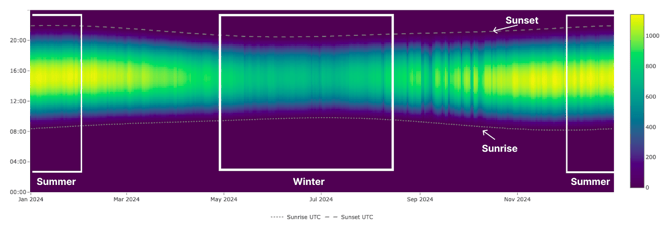 Tropical Southern Country
Another normal pattern we expect in equatorial countries is seasonal variation in weather conditions, such as changes in cloud cover and rainfall. However, unlike higher latitudes, we do not expect significant differences in daylight duration or sun intensity between seasons, since the length of the day remains relatively constant throughout the year, as illustrated in this example.
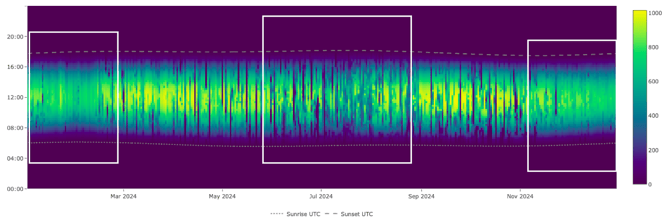
Equatorial Country
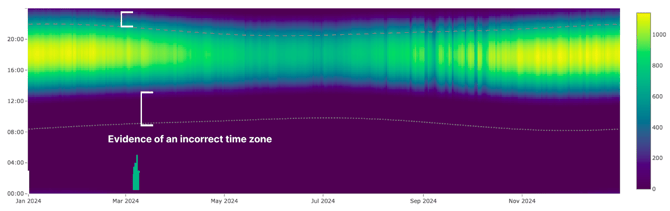
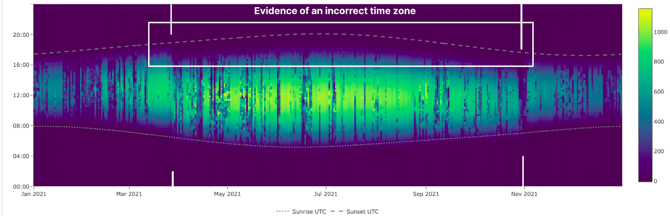
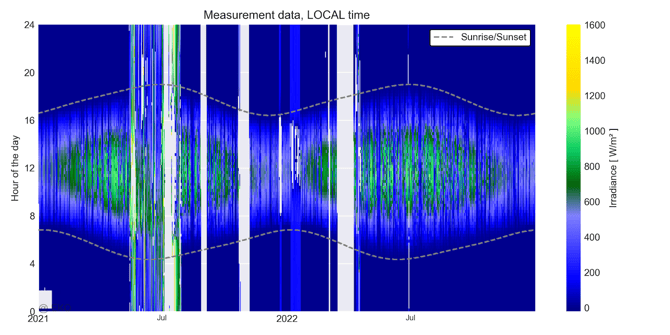
One of the first things to check is whether the data respects realistic sunrise and sunset boundaries. In a correct dataset, irradiance values should only appear between sunrise and sunset, and these boundaries should shift smoothly over the year. If significant irradiance appears clearly outside expected daylight hours, this often indicates a time-related issue, such as an incorrect time zone, missing or incorrect daylight saving time handling, or a fixed time offset in the timestamps. Because such issues affect nearly every subsequent analysis, the carpet plot is an essential early check.
The carpet plot below shown in Local time at a location that practices Daylight Saving Time. Both the irradiance data and Sunset/Sunrise lines are shown with visible discontinuity.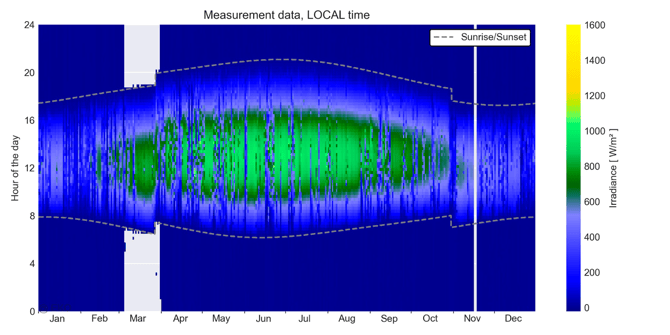
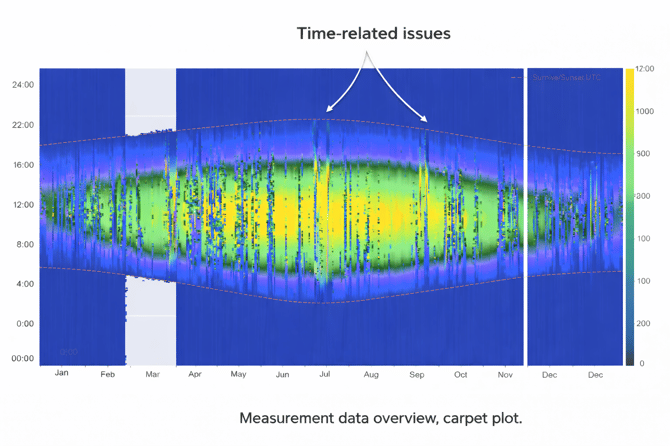
The seasonal pattern visible in the carpet plot should also make sense for the site’s latitude and climate. Summer should show longer daylight hours than winter, and midday irradiance should generally be higher during summer months. Abrupt changes in the daily pattern, such as a sudden shift of daylight hours partway through the year, can indicate changes in logger configuration, time zone settings, or data processing that occurred during the measurement period, during saving, storing, transferring and preparing the data.
Gaps on Carpet plot
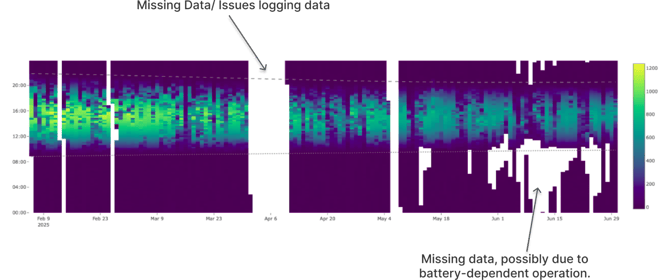
Missing data is particularly easy to spot in the carpet plot. Gaps in the dataset appear as blank or dark stripes where no values are recorded. These gaps may be vertical, indicating missing data over a continuous period, or horizontal, indicating that data is missing at certain times of day. The carpet plot does not judge whether these gaps are acceptable or expected, but it allows users to quickly see their extent, timing, and regularity.
Nighttime data on Carpet plot
Nighttime behavior is another important aspect that becomes visible in the carpet plot. At night, irradiance values should be close to zero, but not necessarily exactly zero. Thermopile pyranometers measure an energy balance, and small negative nighttime values are normal and expected.
In some cases, however, negative measurements are clipped and forced to zero as part of the data processing. In the carpet plot, this appears as a dark or slightly textured background during nighttime hours.
EKO strongly recommends logging all the data and preserving original measured values for both nighttime and daytime. It often simplifies analysis or troubleshooting in the future.
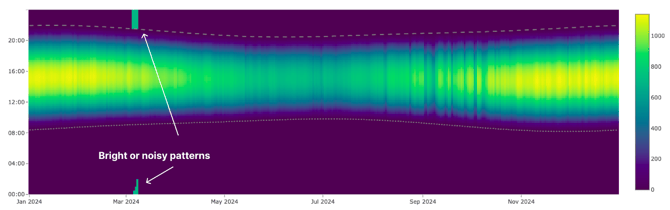
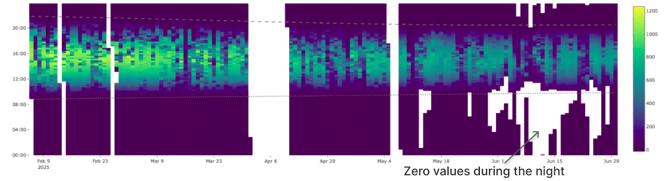
What deserves attention is the presence of bright or noisy patterns at night, large spikes, or long stretches of exactly zero values. Such anomalies may indicate issues with wiring and grounding, logging problems, or data manipulation.
Noisy data on Carpet plot
Cloudiness often makes the carpet plot look irregular or “noisy,” especially during daytime. This is normal and should not be mistaken for a data quality issue. Clouds introduce rapid changes in irradiance, which appear as patchy or uneven coloring. The carpet plot is not intended to show smoothness or accuracy; it is intended to show whether the overall structure of the data makes physical sense.
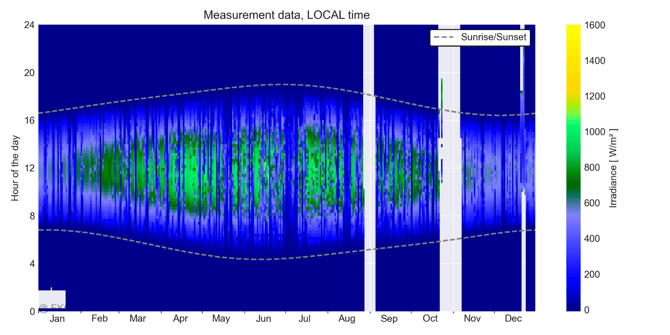
Symmetry of Carpet plot
Carpet plot should follow the symmetry of diurnal and annual cycles in solar irradiance. A visible shift towards morning or evening may indicate tilted installation, persisting shading or accumulation of soiling. Such asymmetry suggests a need for specialized analyses.
Example Plane-of-Array measurements with 30° tilt to East
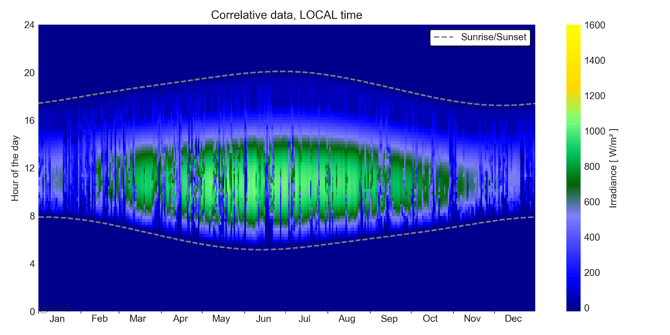
Carpet plot as early consistency check
The reason the carpet plot appears early in the report and even on the Data Preview part of Eko Q is that problems visible at this stage can invalidate many later conclusions. If the data is shifted in time, logged in the wrong time zone, or missing large portions, advanced analyses may produce misleading results. Correcting such issues and rerunning the analysis often resolves multiple warnings at once.
In practice, the carpet plot should be used as a first visual check. If the day–night pattern looks correct, the seasonal changes make sense, gaps are understood, and nighttime behavior appears plausible, then the dataset is likely suitable for deeper analysis. If not, the carpet plot has already fulfilled its purpose by indicating where attention is needed before proceeding further.
It is also important to understand what the carpet plot cannot tell you. It does not provide reliable information about calibration accuracy, small orientation errors, or subtle shading effects. Those questions are addressed later in the report using more targeted analyses. The carpet plot’s purpose is not precision nor details but validation of basic consistency and realism at a large scale.
The carpet plot is part of the Data Integrity section of the report. For the full context of the checks performed in this section, see Understand Data Integrity checks in the Detailed Report.