

In the EKO Q Data Quality Report, the “Absolute irradiance difference – All conditions” plot appears in the Agreement with Reference Data section. This section evaluates how well the measured sensor data agrees with the selected reference data.
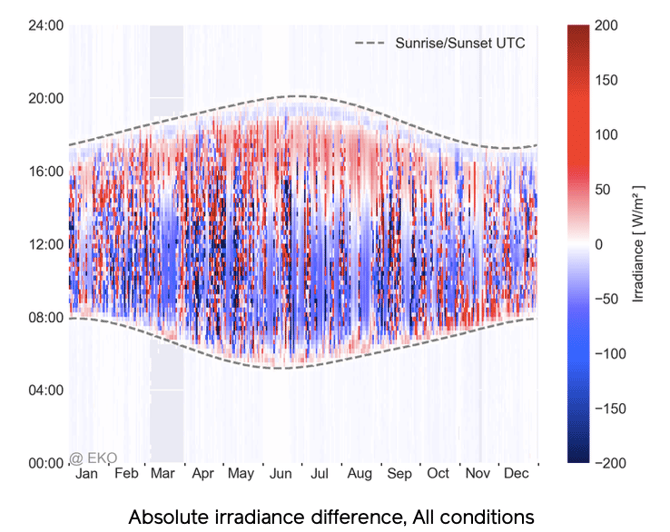
This plot visualizes the difference between the on-site sensor measurement and the reference estimate for every hour of every day during the analysis period. It shows the difference between the measured data and the reference model just like the usual Carpet plot does for the irradiance values.
The horizontal axis represents the day of the year, while the vertical axis represents the hour of the day. The dashed curves indicate sunrise and sunset. The color scale represents both the magnitude and direction of the difference in watts per square meter.
When the plot shows blue, the sensor is measuring lower irradiance than the satellite model estimate, meaning it appears to be underestimating relative to the reference. When the plot shows red, the sensor is measuring higher irradiance than the reference estimate, meaning it appears to be overestimating relative to the reference. Areas close to neutral colors indicate good agreement.
Because this version uses all conditions, it includes both clear-sky and cloudy periods. The purpose of this plot is not to demand perfect agreement, but rather to detect systematic structure in the differences.
Within the logic of the report, the key question this plot helps answer is whether the differences are random or whether they follow a consistent pattern. When compared to a model data such as satellite data, randomly scattered red and blue regions throughout the year are generally expected and reflect natural atmospheric variability or the model uncertainty. However, when the plot shows a clear and structured pattern, this typically indicates that something should be investigated.
Sometimes, the Difference Carpet plot helps you see patterns even when automated analysis lacks resolution to be conclusive.
Pattern of red and blue separation
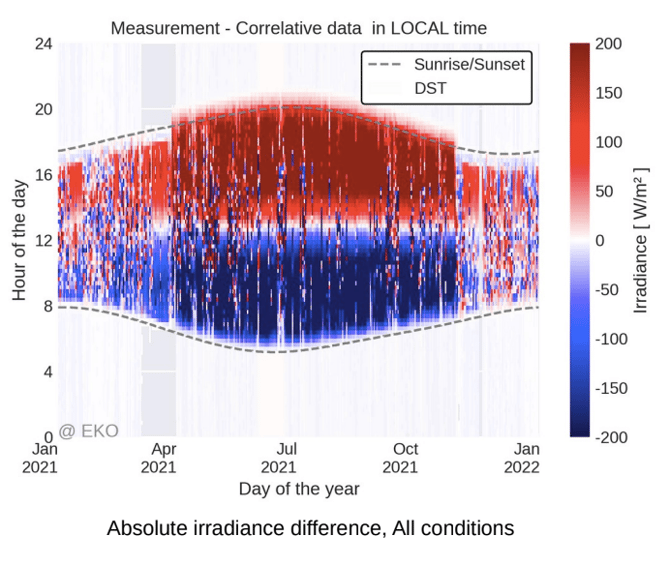
If there is a consistent separation where red dominates the upper portion of the plot and blue dominates the lower portion, or the opposite configuration persists throughout a long period, this suggests a systematic issue rather than normal variability. A strong and repeated top–bottom color separation often points to configuration or installation problems such as time shift errors, incorrect time zone settings, sensor orientation misalignment, tilt or azimuth deviations, or tracking issues. When the same structured pattern appears day after day, it should be checked carefully.
Here are some examples of how it can look like: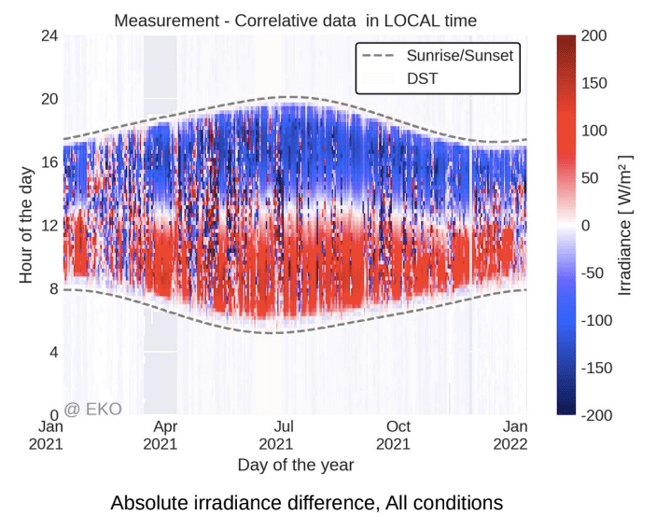
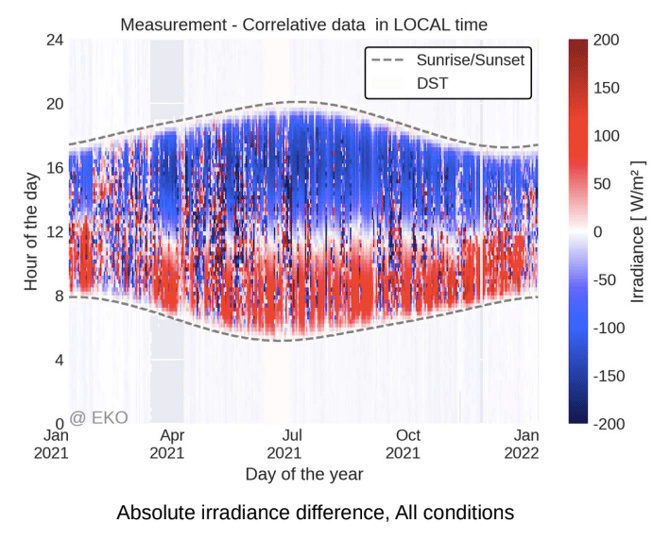
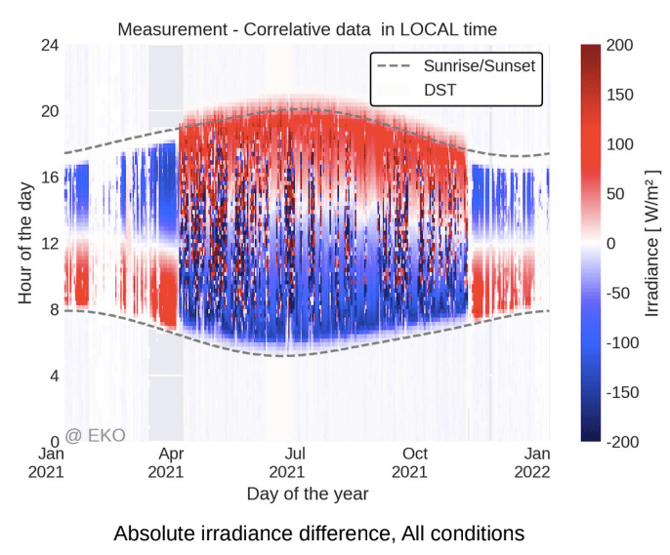
Repeating behaviour day after day
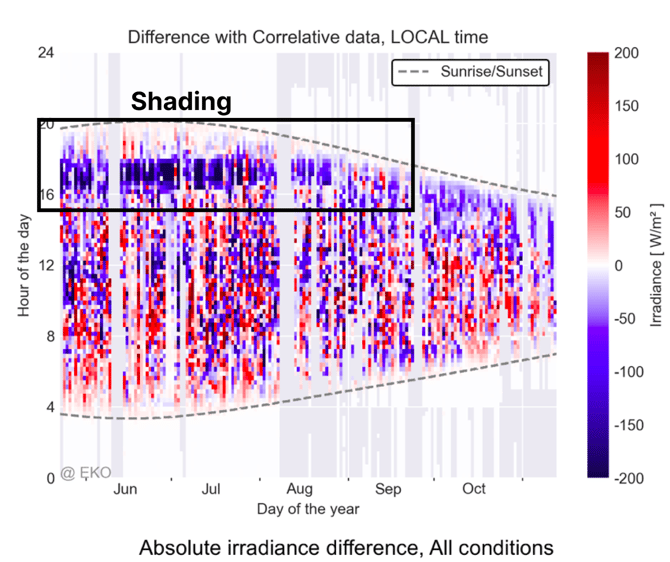
When the plot is mostly balanced, more subtle patterns can become apparent.
This plot shows a consistent underestimation at the same time in the afternoon, caused by the shadow of a tall building nearby.
Consistent bias
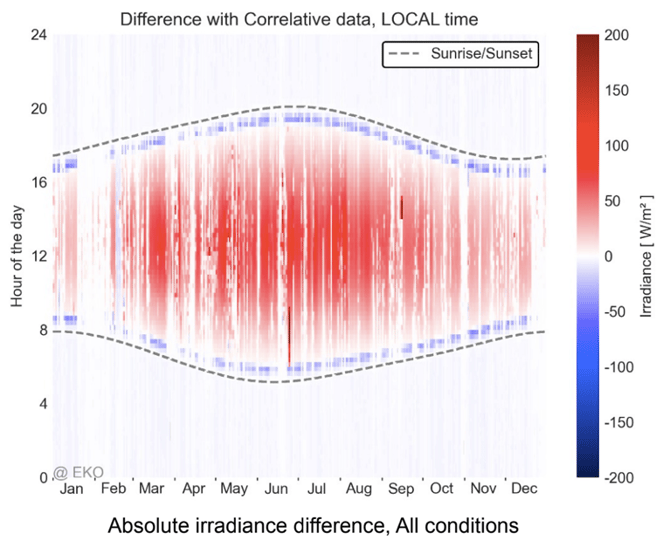
If the entire year shows a predominantly light blue or light red tone, this may indicate a scaling or gain difference between the measurement data and the reference, which is also summarized in the bias and gain tables in the same Agreement section.
If stronger differences are concentrated at low sun angles near sunrise or sunset, the cause may be shading, reflections of surrounding, or geometric effects, which are evaluated in the Nearby Shading section.
This example shows a consistent overestimation of the sensor under test compared to the reference sensor on site, except for very low sun elevations where there a shading of some sort dominates.
Weather patterns
Periods of clear sky and overcast are often distinctly visible on the plot as consistent agreement while periods with intermittent clouds appear “noisy”.
Depending on the measurement and analysis setup, some patterns seen in the data are expected and can serve to confirm assumptions.
When comparing measurement data to satellite data or other models, a good agreement can be expected during clear sky periods while cloudy days produce more uncertainty in model data.
When comparing measurement data to a reference measurement data on site, the agreement is typically better under cloudy conditions and especially under overcast sky. This is expected because direct sunu irradiance is mostly blocked, and pyranometer measurements are less sensitive to mistakes in installation, temperature and directional response, thermal offsets and even soiling.
In summary, the “Absolute irradiance difference – All conditions” plot is a diagnostic visualization tool within the structure of the EKO-Q report. It shows where and when the sensor and the reference data disagree, using color to indicate underestimation in blue and overestimation in red. When clear and repeated red–blue structures appear, especially in a consistent top–bottom configuration, this is a strong indication that something in the installation or configuration should be reviewed. The plot should always be interpreted together with the bias metrics, gain estimates, time shift analysis, orientation tests, and shading assessment provided in the surrounding sections of the report.
The Clear Sky conditions counterpart provides extra insights through similar visualisation focused on data collected with mostly clear sky.
Go back to: Read and Understand the Carpet Plot