

Global coverage and region dependency
EKO Q is designed to support data quality analyses in any location, globally.
Some analyses require external data such as irradiance model data, weather data, terrain data etc. Spatial coverage of these data sources directly impact the spatial coverage of respective analyses.
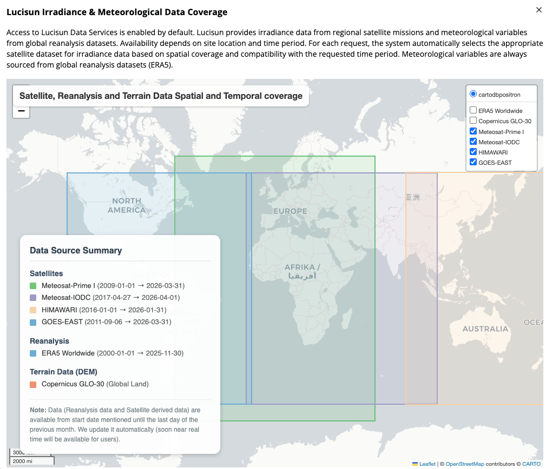
The main external data that impacts spatial coverage are Satellite-based Full Sky irradiance data. The default sources in EKO Q include:
-
LUDATA data service by LuciSun, also known as LUC, available right after sign up to EKO Q
-
CAMS data services by Copernicus Programme, available once you provide your own credentials to the service (see Setup correlative data)
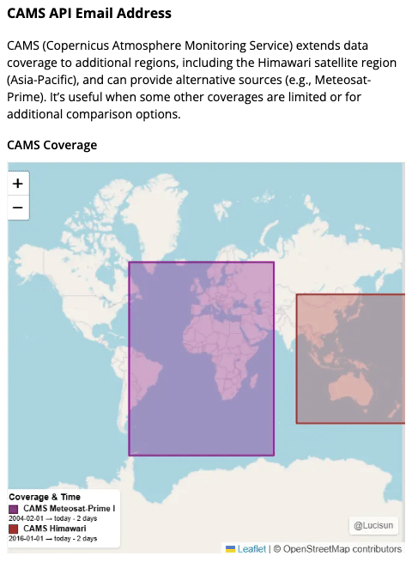
Respective spatial coverage of the two data services is provided in API Token Management page in EKO Q. You can also see respective documentation at LuciSun and CAMS websites.
Spatial coverage of required irradiance data sources
Analyses in EKO Q rely on external data sources which affect the spatial coverage of the analysis as a whole.
Spatial Coverage of Key Analyses
The following table summarises spatial coverage of the data analyses in EKO Q based on key dependencies.
| Europe | Africa | MIddle East |
India, Indian Ocean
|
East Asia, Australia
|
North America
|
Central America
|
South America
|
Polar Regions
|
Pacific Ocean | |
| Site and sensor configuration | Yes | Yes | Yes | Yes | Yes | Yes | Yes | Yes | Yes | Yes |
| Data import | Yes | Yes | Yes | Yes | Yes | Yes | Yes | Yes | Yes | Yes |
| Configuration checks at data Import | Yes | Yes | Yes | Yes | Yes | Yes | Yes | Yes | NO | Yes |
| Single Sensor Analysis, using LUC data (default) | Yes | Yes | Yes | Yes | Yes | Yes | Yes | Yes | NO | Part |
| Single Sensor Analysis, using CAMS data | Yes | Yes | Yes | NO | Yes | NO | NO | Part | NO | NO |
| GHI Measurement Reference Analysis | Yes | Yes | Yes | Yes | Yes | Yes | Yes | Yes | Yes | Yes |
| Fleet Analysis* | Yes | Yes | Yes | Yes | Yes | Yes | Yes | Yes | Yes | Yes |
Space and time
Spatial coverage (Data from what location can I analyse?) should be considered along with Temporal coverage (Data for what period can I analyse?) It is typical for advanced data sources to have a couple days lag in data availability and be limited in historical horizon.
-
For example, CAMS Radiation Service offers historical irradiance data in Europe since the year 2004 until yesterday (day-1). It means that a location within CAMS coverage may still lack today's data, which will become available tomorrow.
-
As another example, LuciSun offers a monthly update cycle with the focus on consistency for long-term analysis.
Automatic selection
When you configure an Analysis for a site, more than one data source is often available to choose from. EKO Q automatically guides you to choose between the available options based on site location and period of analysis that you choose.
You can simply rely on automated selection. You can also select your preferred option.