

The linearity plot and corresponding numerical metrics provide a quick visual assessment of how consistently the measurement data agrees with the reference data across the full irradiance range.

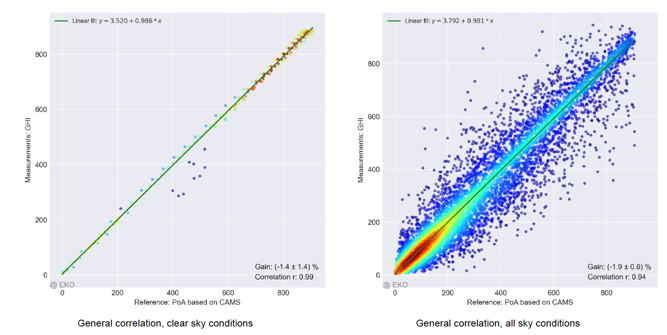
In the linearity plot, the measurement data is displayed on the Y-axis, while the corresponding reference data is displayed on the X-axis. Each point represents a pair of simultaneous irradiance measurements.
When both datasets agree perfectly, all points lie on the 1:1 line, with a gain of 1 and a correlation coefficient of 1. This indicates identical values in both datasets.
Systematic deviations from this line can reveal different types of measurement issues. For example:
- A consistent offset may indicate calibration or zero-offset errors.
- A slope different from the 1:1 line may suggest gain errors, sensitivity mismatch, or systematic underestimation or overestimation.
- Increased scatter may indicate noise, instability, timing mismatch, sensor orientation issues, or changing environmental conditions.
- Nonlinear patterns may point to sensor response limitations, saturation effects, shading, or data processing issues.
The plots and numerical metrics are provided separately for:
- data filtered for clear-sky conditions, and
- data representing all-sky conditions.
Common Patterns
1. Mostly linear relationship
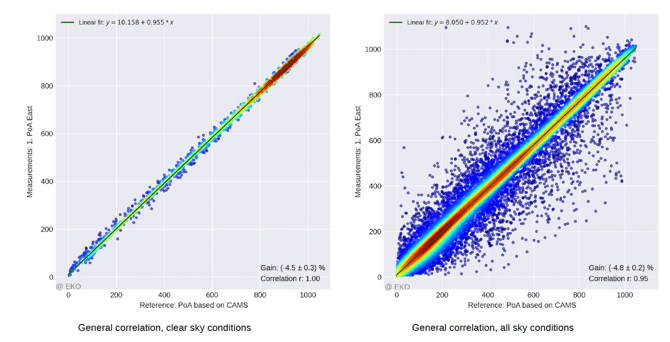
This is the expected pattern for high-quality data. Small deviations are typically caused by limitations in the reference data and natural variability in weather conditions.
Pay attention to the reported gain and compare it with the expected accuracy of both the measurement instrument and the reference data source.
2. Oval-shaped patterns
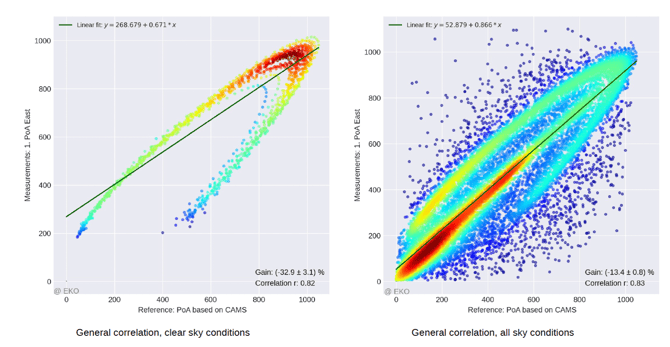
This pattern is typically associated with a time shift or incorrect sensor orientation. In such cases, the measurement data systematically overestimates irradiance in the morning and underestimates it in the afternoon, or vice versa.
Keep in mind that similar effects may also originate from issues in the reference data itself.
The linearity analysis cannot provide reliable conclusions when such mismatches are present. Verify the basic system settings and review other sections of the report, particularly Time Shift and Sensor Orientation.
3. Very strong linear relationship

This is the expected pattern when comparing high-quality measurements with data from a trusted reference instrument.
Although this analysis cannot replace a proper calibration procedure, it can provide a useful starting point for investigating calibration accuracy.
Keep in mind that such a strong linear relationship between measurement data and model-based irradiance data is highly unlikely and should be investigated as a potential indication of data manipulation.
Final note
General Linearity should be used as a quick indicator of overall agreement, not as a standalone diagnosis. Any systematic deviation, unusual scatter, or unexpected linearity should be reviewed together with the reference data source and other report sections, especially Time Shift and Sensor Orientation.
If the agreement changes depending on the sun’s position, it may also be useful to review Correlation with Solar Zenith Angle.