

Comparing measurement data against a trusted reference is one of the most natural and effective ways to assess data quality. The principle is straightforward: datasets representing the same irradiance at the same location should show strong agreement. By visualising and quantifying the differences, EKO Q helps evaluate data consistency, identify anomalies, and reveal recognizable patterns that may warrant further investigation.
The Agreement with Reference Data section of the report provides plots and numerical results that help you visualise and quantify the level of agreement between the measurement data and the selected reference.
Agreement with reference data should be used as a practical guide for assessing data quality, not as a standalone diagnosis. The interpretation of the results depends on the selected reference source, measurement setup, environmental conditions, sensor class, maintenance history, and data filtering criteria.
Before interpreting agreement results, it is important to check whether missing or compromised samples were detected, as these can affect later comparison tests. For more details, see Understand Data Integrity checks in the Detailed Report.
Timestamp errors can significantly affect the agreement between measurement data and reference data. For this check, see Time Shift Test.
Incorrect sensor orientation can also affect the agreement with reference data. To verify the estimated tilt and azimuth, see Sensor Orientation Test.
When significant deviations or recognizable patterns are observed, they should be reviewed together with the detailed report results and, where possible, compared against additional independent references.
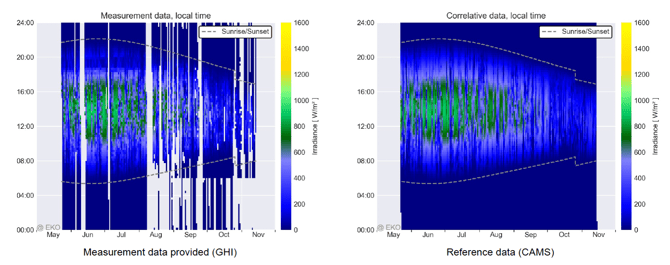
This section is divided into two parts:
-
Agreement over Time, which focuses on how the differences between the datasets evolve over time, see more under Agreement over Time.
-
Aggregated Agreement, which summarises the overall relationship between the datasets and analyses the differences in relation to key parameters. This includes General Linearity and Correlation with Solar Zenith Angle.
Use the insights from both sections to detect recognisable patterns, confirm or reject assumptions, and further investigate the quality of your data.
Choosing the reference data is key
Independent measurements, redundant sensors, nearby measurement stations, and satellite-based irradiance models are among the most common sources of reference data. Each option has its own strengths and limitations, and each provides a different perspective on measurement quality and system performance. Depending on the quality criteria used, some reference sources may be more suitable than others. For a more robust assessment, it is recommended to compare measurements against multiple independent references whenever possible.
Satellite-based irradiance models
Satellite-based irradiance models are developed using satellite imagery and atmospheric modelling. They have improved significantly over recent decades and are now widely used for general irradiance assessment.
However, model data should rarely be considered more accurate than high-quality onsite measurements. In practice, the opposite is often true: trusted ground measurements are commonly used to validate and improve satellite models. Nevertheless, satellite-based data remains highly valuable for quality control because it can help assess overall data consistency and detect patterns that may indicate systematic issues in the measurement system.
Satellite-based irradiance data is designed to provide a smooth, large-scale representation of irradiance conditions. It generally agrees well with high-quality onsite measurements over longer time periods, such as annual averages, but is often less accurate at specific moments in time.
In practice, annual agreement may be within approximately ±5% under favourable conditions. Monthly agreement is typically within ±20%, while hourly differences can often exceed 30%.
Because of these limitations, satellite-based data should not be used to evaluate irradiance measurements at specific moments in time, perform remote calibration of high-accuracy instruments, or support other applications that require highly precise short-term agreement.
Reference sensor measurements
International standards for pyranometer calibration, such as ISO 9847:2023 and ISO 9846:2025, recommend using a trusted, co-located higher-class reference measurement system. This approach represents standard industry practice for sensor evaluation and calibration.
Co-located sensors measure the same irradiance conditions, allowing direct comparison between datasets. These comparisons can reveal subtle differences related to sensor design, specifications, calibration, maintenance, and environmental exposure.
Accurate sensor-to-sensor comparison requires a high level of confidence in the reference sensor, including its calibration history, characteristics, and maintenance status. In addition, the relevant standards require strict data filtering procedures to support reliable conclusions.
These requirements can be difficult to achieve in field conditions. However, redundant sensors installed according to IEC 61724-1 are typically exposed to the same environmental and maintenance conditions and are often connected to the same data acquisition system. This helps separate external influences from sensor-specific behaviour.
Direct sensor-to-sensor comparisons are useful for identifying effects such as calibration mismatch, small orientation errors, directional response differences, and soiling.
Final note
Agreement with reference data is a useful guide for assessing data quality, but it should not be used as a standalone diagnosis. Results should be interpreted together with the reference source, measurement setup, environmental conditions, sensor class, maintenance history, and filtering criteria. When significant deviations or patterns appear, they should be checked against the detailed report and, when possible, additional independent references.
Before interpreting agreement results, it is important to check whether missing or compromised samples were detected. For more details, see Understand Data Integrity checks in the Detailed Report.