

Solar irradiance is expected to be zero at night, and nighttime data is often ignored in many solar applications. However, nighttime measurements provide valuable diagnostic information. They can reveal issues in the measurement setup that remain hidden during the day, when high irradiance levels mask small errors.
The Nighttime Readings test provides a quick assessment of whether nighttime irradiance data shows any signs of problems. The summary table includes key indicators such as the number of nights available for analysis, the average nighttime irradiance, and the number of nights with unusually large readings.

The accompanying plot visualizes the raw data, allowing for a more detailed review.
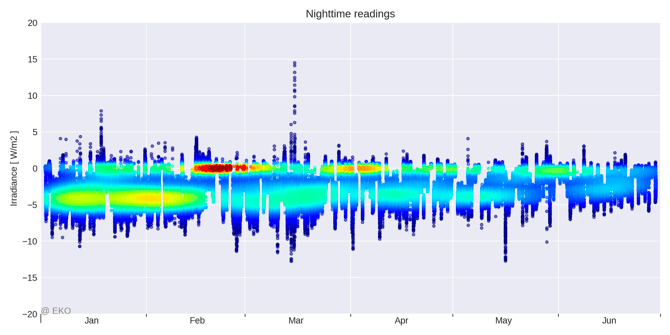
If the test fails or the plot shows unusual patterns, further investigation is recommended. In most cases, incorrect nighttime readings also indicate issues in daytime measurements, even if they are not immediately visible.
Why Nighttime Irradiance Is Not Always Zero
Non-zero nighttime readings can result from both expected and unwanted effects. Thermal offset is a normal characteristic of pyranometer measurements, while issues such as incorrect wiring or electrical interference indicate problems.
Proper installation and maintenance are essential. This includes correct cabling, secure connectors, appropriate grounding, and protection against mechanical damage. Poor installation or maintenance can introduce unwanted signals and lead to unreliable data.
1. Expected measurements due to thermal offset
Thermopile pyranometers measure energy flux, which includes not only solar irradiance but also infrared thermal exchange between the sensor and its surroundings.
At night, this thermal exchange dominates the signal. The effect, known as thermal offset, is well understood and specified in standards such as ISO 9060:2018. A Class A pyranometer may show small readings of a few W/m², often negative. This occurs because the effective temperature of the clear night sky is very low, causing the sensor to lose more energy than it receives.
The magnitude of this offset varies with temperature, weather conditions, and sensor state. During the day, it is negligible compared to solar irradiance (which can reach around 1000 W/m²). At night, however, it becomes the dominant signal and should remain within a few W/m², depending on the sensor class.
2. Grounding issues
Pyranometers are sensitive instruments and can be affected by surrounding electrical signals. Proper grounding of both the sensor body and its cables is essential to ensure accurate measurements. Manufacturers typically provide clear grounding instructions, and failing to follow them can introduce a bias in the signal. This bias is then interpreted by the datalogger’s analog-to-digital converter (ADC) as a false irradiance value.
For example, the EKO MS-80 should be grounded at the measuring device through the cable. If no grounding is applied, the system may develop a floating potential. On the other hand, additional grounding points can create a grounding loop. In both cases, measurement bias and noise can be introduced, and the system becomes more susceptible to electrical interference.
Bias caused by incorrect cabling is often not noticeable during the day but can still affect measurement accuracy. It typically varies over time and may increase as the electrical activity of the solar power plant changes.
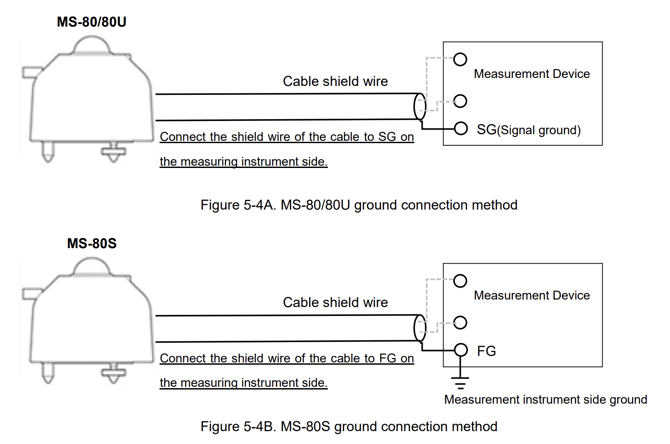
The impact of incorrect grounding is particularly significant for sensors with analogue interfaces. Pyranometers with built-in ADCs and digital outputs are generally less sensitive to these issues.
Mechanical damage can also contribute to grounding problems. Scratches on the sensor body or mounting feet may damage the protective anodized layer and create unintended electrical connections. When combined with moisture or dirt, these connections can introduce a time-varying bias in the measurements.
3. Moisture in cable connectors
Moisture caused by precipitation or condensation can create unintended electrical connections. This can act as additional grounding or even cause a partial short circuit, leading to biased measurements.
To prevent this, always connect sensors according to the user manual, ensure all connectors are properly tightened and sealed, and use appropriate tools to avoid scratches or other damage.
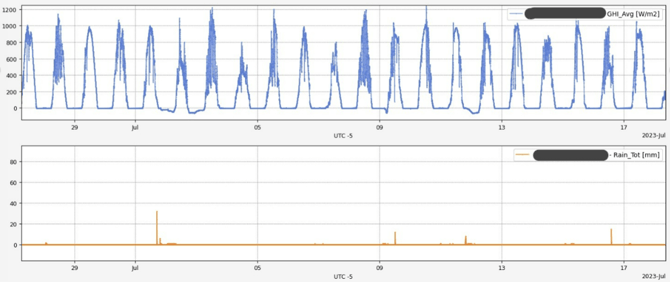
The plot below illustrates the effect of damaged insulation combined with moisture. This issue is often difficult to detect during the day but becomes clearly visible at night. A significant bias may appear after rainfall and gradually disappear as the system dries.
How to Read the Nighttime Readings Plot
The plot shows only nighttime data, with time on the X-axis and irradiance values on the Y-axis. The Y-axis is limited to a small range to highlight small deviations around zero.
Each point represents a measurement (raw or aggregated). The color indicates how often values occur, ranging from blue for individual points to red for more frequent values.
Typical Patterns
1. Readings around zero, often slightly negative (within a few W/m²)
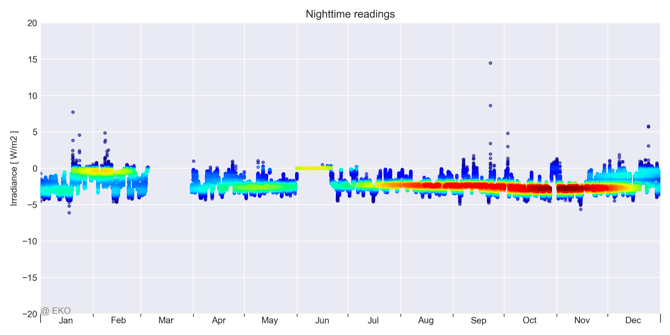
This is the expected pattern for a healthy irradiance measurement system using a thermopile pyranometer.
In this type of plot, you may observe noise-like variations around zero, reflecting natural changes in environmental conditions. The values are typically slightly negative, which is normal due to thermal offset. For a Class A sensor, the readings should generally remain within ±10 W/m², while higher-performance models such as the EKO MS-80SH may show even smaller offsets. Lower-class sensors may exhibit larger deviations.
It is also common to see distinct levels in the data. For example, slightly negative values may correspond to cloudy nights, while values around −4 W/m² are typical for clear-sky conditions.
Additional features may appear in the data, such as periods of missing nighttime measurements, occasional clipping of values to zero, or isolated outliers caused by rapid temperature changes or other environmental effects.
2. Zero readings
Thermopile pyranometers almost never produce exactly zero readings at night. Even high-performance sensors, such as the EKO MS-80SH, have a very low thermal offset and typically show small values within ±1 W/m². As in the exemple bellow:
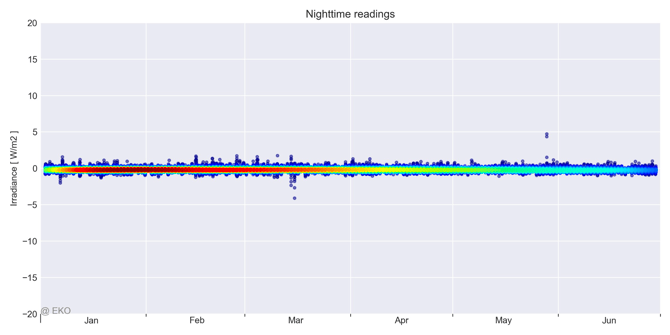
If your data shows exact zero values, it may indicate an issue. In some cases, this can be expected when using other sensor technologies or modelled irradiance data, which often report zero at night.
To investigate, first confirm that the data comes from a thermopile pyranometer and review the sensor specifications for expected thermal offset. Then check whether negative values have been clipped or removed during data preprocessing. It is also important to verify number formatting and rounding in the datalogger and data processing settings. EKO recommends recording irradiance data with at least one decimal place.
Finally, review other tests as well, as issues such as incorrect units of measurement may also lead to misleading results.
3. No readings at night
In some cases, nighttime data may be removed during preprocessing. While this is a common data-cleaning practice, EKO recommends keeping nighttime measurements for diagnostic purposes, as they can provide valuable insight into potential issues with the system.
4. Significant positive irradiance
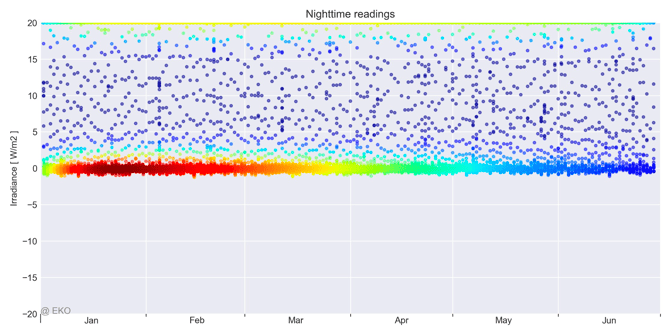
A pattern with significant positive values at night, often with many data points clipped, may indicate that daytime data is being incorrectly treated as nighttime.
In this case, check the system and analysis settings, including sensor location and timezone.
5. Highly irregular data
Highly irregular or inconsistent data may indicate multiple underlying issues and is often accompanied by failures in other tests. In this case, review the results of other tests and carry out further investigation to identify the root cause.
Final Note
Nighttime data provides a simple but powerful diagnostic tool. Even small deviations can reveal underlying issues in the measurement system. For this reason, nighttime readings should always be reviewed alongside other tests to ensure overall data quality.