

What is this about?
The information that you provide about your system is the basis of all the analysis. It has its own data quality story to tell. EKO Q brings in other sources of data such as irradiance model data.
This section summarises the input data used and highlights important points that may affect the irradiance data analysis.
Why this matters
Solar data analyses use various external data and assumptions based on system location, climate, weather conditions, system size etc. While assumed correct, they all carry their own limitations and uncertainties which may significantly impact results of your analysis. Moreover, critical information about the system is often provided with mistakes and would better be checked.
This section helps you keep an eye on the input data before it impacts the results of your analysis.
How to read the results
Site Information
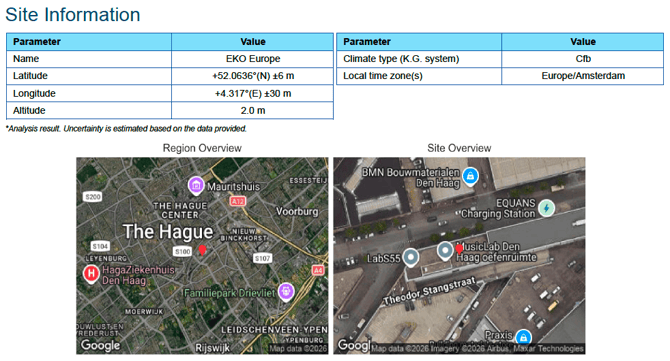
Geographical location is critical for solar irradiance modelling. Sensor latitude, longitude and altitude impact solar angles, horizon shading, temperature profiles.
Check that aerial overview, information about climate type and time zone for the location are correct and accurate.
Precision of 4 decimal (±0.0001°) for both latitude and longitude is recommended - it roughly corresponds to ±10 m. Precision of two decimals (±0.01°, roughly ±1 km) may be tolerable for large sites in flat areas.
Precision of ± 2 m for altitude is good for most cases. Typical precision of ±50 m of terrain altitude obtained automatically through EKO Q is typically enough for PV sites.
Irradiance Sensor Information
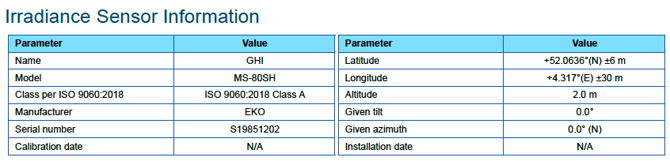
Details of the irradiance sensor should always be provided along with irradiance data. Check that this information matches your expectations.
High quality data requires high quality instrumentation. For Class A Monitoring systems per IEC 61724-1:2021, ISO 9060:2018 Class A thermopyle pyranometers such as MS-80SH are required.
Reference Data Information
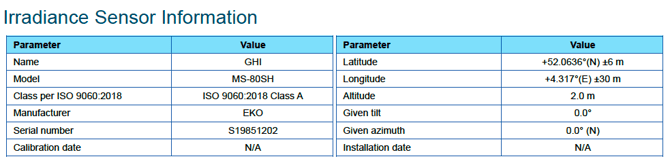
This section lists main details about external data sources used in the analysis. This information may be helpful to assess uncertainties of analysis results and derive conclusions.